
The Definitive Guide to SEO Dominance in 2026
Introduction: The Death of the Single Keyword
For so many years, the SEO world has been a “whack-a-mole” process. Find a keyword, optimize a page for that keyword, and then go on to the next one. But as we begin the year 2026, the search algorithms employed by Google, fueled by sophisticated neural networks and generative AI, have evolved beyond the simple process of keyword recognition. They seek to uncover intent and expertise.
The secret to getting your site to rank today is no longer based on having the “best keyword density” but instead on having the “highest Topical Authority.” This 1,000-word guide will walk you through the relevance of topical authority in the SEO world and give you a blueprint on how to make your site the “Source of Truth” in your niche.

Section 1: What is Topical Authority (And Why it’s 2026’s #1 Metric)?
Topical authority is a method of measuring the depth of knowledge and perceived expertise of a website on a given topic. Unlike traditional “Page Authority,” which is focused on the strength of a given URL, Topical Authority looks at your entire site’s ecosystem.
The Shift from “Strings to Things”
Google’s Knowledge Graph looks at concepts as “entities.” When you talk about “Electric Vehicles,” Google wants to see information about battery technology, charging stations, the best brands, and how it impacts the environment. If you’re just talking about “The Best EV for 2026,” you’re not covering the “entities” that need to be covered to be considered an Topical authority on the topic.
Why It Matters Now:
AI Overviews (SGE): Google’s AI-driven overviews want to cite sources that have covered the topic from every angle.
The E-E-A-T Standard: Experience, Expertise, Authoritativeness, and Trustworthiness are shown through a library of high-quality, relevant content, not a single lucky hit.
Section 2: The Anatomy of a Topic Cluster
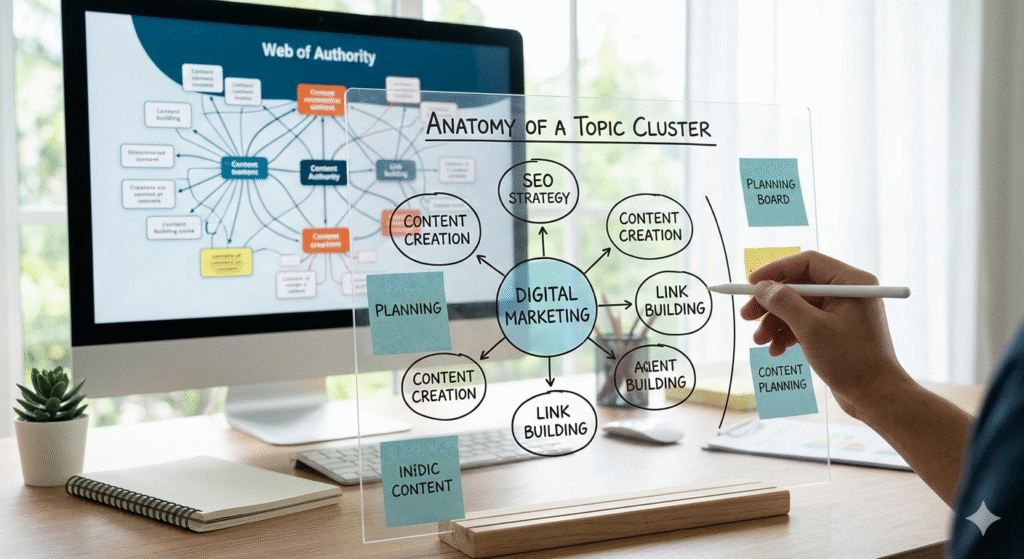
In order to rank, you must organize your content into Topic Clusters. This will allow you to tell search engine crawlers exactly how your information is related to Topical authority
1. The Pillar Page (The Hub)
Your Pillar Page is a massive, high-level page that covers a very general topic. It should be a minimum of 2,000 words and touch on all sub-topics briefly, linking to more in-depth “cluster” articles.
Example: “The Ultimate Guide to Digital Marketing.”
2. Cluster Content (The Spokes)
These are 800-1,200 word articles that answer very specific long-tail questions in-depth.
Example: “How to Optimize Meta Tags for Voice Search in 2026.”
3. The Internal Linking Bridge
This is the “glue.” Every cluster article must link back to the Pillar Page, and the Pillar Page must link to every cluster article. This creates a semantic loop that boosts the ranking potential of every page in the cluster.
Section 3: Blueprint to Building Authority
Step 1: Audit Your “Content Gaps”
Don’t wonder what to write. Find out what your competition has written about that you haven’t. If you are an authority on “Coffee,” but you haven’t written about “Cold Brew Extraction Science,” you have a gap that damages your Topical authority.
Step 2: Semantic Keyword Research
Stop searching for “High Volume” keywords only. Search for Semantic Relevance. Use “People Also Ask” (PAA) boxes to see what natural questions people are asking. In 2026, search is conversational.
Step 3: The “Information Gain” Factor
Google’s 2026 algorithms favor “Information Gain.” If your blog post says the same thing as the top 5 results, why should Google show it to people?
Add Original Data: Conduct a poll or report your own sales figures.
Unique Perspective: Write a contrarian opinion on an industry topic.
Custom Visuals: AI can’t create your brand’s specific graphics.
Section 4: How E-E-A-T and human experience work together
AI can generate 1000 words in 5 seconds․ Human Experience (the extra ‘E’) is what’s going to keep you ahead․
How to Prove Your Experience to Your Readers․
Case Studies: “How we helped Client X increase revenue by 40%․”
Testing & Reviews: “We spent 30 hours testing these 5 tools․”
Author Transparency: Don’t forget a full author bio on every post with a link to your verified LinkedIn or social profile․ Google wants to see the real person and credentials behind the advice․
Section 5: Advanced Technical Signals for Topical Authority is not just what you say, but how computers interpret what you say. Schema Markup (JSON-LD) Use About and Mentions schema to tell Google exactly what entities your page is talking about. This will help you get into the Knowledge Graph. Site Structure and Breadcrumbs A “flat” site structure is a disaster for authority. Use logical folders (such as website.com/SEO/topical-authority) to mirror the structure of your knowledge.
Section 6: Measuring Your Success
How do you know if you’re becoming an authority?
Keyword Breadth: You start ranking for keywords you didn’t even specifically target.
Referral Traffic: Other people start linking back to you as a source of information.
Search Console “Impressions”: You see that your impressions are increasing even if your clicks aren’t—this means Google is “testing” your authority in more categories

Conclusion: The Long-Term SEO Investment
Topical authority is not a hack. It is a long-term investment in being the best resource on the internet for a given topic. While everyone else is trying to keep up with the latest algorithm update, the “Authority Site” remains steadfast because it offers the value that search engines are meant to find.
Get started today: Choose one topic related to your business and write 10 cluster articles in the next month. See your rankings improve.